
230 Deals in 3 Years: Making Millions in Mobile Homes w/ Jacob Kline
Hosted by Mike DeHaan, Dan Austin, Dylan Koch · Guest: Jacob Kline
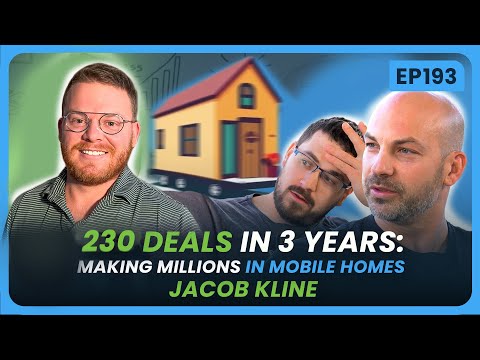 ▶ Watch this episode on YouTube
In this episode
Jacob Kline walks through how he went from a vape-coil business and zero real estate experience to roughly 150 flips and 230 total deals in four years, with 13 rental doors including an eight-unit. He explains why about 75% of his volume is double-wide mobile homes on land, how he built a 15-person in-house construction team, and how he finances deals with private money. He and the hosts also argue through the opportunity cost of keeping rentals versus recycling capital into flips.
Key takeaways
- Jacob started with cold calling from county records off YouTube advice and closed a $25k wholesale deal within about a month — and admits he left roughly $20k on the table by underselling it.
- His niche is double-wide mobile homes on land: buying in the $70k–$120k range with ARVs around $240k–$280k, in a category many investors throw away.
- He spent his first two years wholesaling solo before his first hire, and only scaled flips after freeing up his time with a lead manager and acquisition manager.
- Construction is fully in-house with close to 15 people and a team lead on each crew, so he spends under ten hours per flip after closing and pays no contractor markup.
- Mike and Dan pushed him toward unsecured business lines of credit — often $50k per bank, stackable across banks at roughly 8–9% — as cheaper, more flexible capital than private or hard money.
- Jacob says he doesn't really view cash flow as a thing; if capital recycled through flips returns 150–200% a year, leaving $100k of equity in a rental earning ~$6k is hard to justify.
- His best deal: buying three condo units from an owner who also ran the HOA, assembling all the units, converting the complex to an apartment building, buying at $1.1M plus $200k in rehab and appraising at $2.6M on refi at 4.5%.
Show notes
With a record of 150 flips and 230 deals in three years (having lost money on just ONE), Jacob Kline’s accomplishments in real estate are nothing short of impressive.
In this episode, Jacob reflects on how he jumped into the world of real estate with zero experience and built a name for himself in a crowded market. He shares the key factors that contributed to his success, including running a lean operation, his strong work ethic, and focusing on the untapped potential in niche markets like mobile homes.
Jacob delves into the systems that have allowed him to streamline operations and scale his flipping business, such as having an in-house construction team, consistent marketing and follow-up, and more. Along with hosts Mike and Dan, he also debates the pros and cons of prioritizing passive income and cash flow in your business.
For insights on investing in mobile homes, flips or scaling your real estate business, don’t miss this episode!
Topics discussed in this episode:
The early phase of building his real estate businessHow Jacob succeeded as a solopreneur and then entrepreneurFinancing flips and scaling his businessRunning a flipping business and in-house construction teamKeeping properties versus reinvesting in your business Connect with Jacob Kline:
Check out the FREE Collecting Keys “Sub To Transactions” Master Class!
If you’re an established investor with money to invest, but not the time, check out the Instant Investor PRO Program! https://collectingkeys.com/
Check out the Big Dan Energy shirt (and more!) in the Collecting Keys Merch Store: https://store.collectingkeys.com/
Download the FREE 5-Step Guide To Generating Off Market Leads here: https://collectingkeys.com/free/
If you are interested in learning from Dan and Mike to receive coaching and learn how they built their business, head to https://collectingkeys.com/keyscon-2023/ and see if you are a good fit for the mastermind group!
Collecting Keys Podcast Resources:
Frequently asked questions
How does Jacob Kline make money on mobile homes?
He focuses on double-wide mobile homes on land, buying roughly in the $70k to $120k range with after-repair values of about $240k to $280k. It's a category many investors don't understand or simply pass on, which keeps competition low.
Should you keep flips as rentals or sell and reinvest?
Jacob and the hosts argue the math usually favors reinvesting. If $100k of equity produces around $6k a year in a rental but the same capital can return 150–200% a year cycled through flips, keeping the property is often more emotional than logical — though appreciation and tax offsets are reasons Jacob still plans to add rentals.
How do you get a business line of credit for real estate?
Dan explains most banks will extend up to about $50k with very little information, so you can stack lines across multiple banks. Use and renew the line responsibly each year and request increases to get to $100k–$150k per institution, unsecured and typically around 8–9% interest.
Land & Mobile HomesScaling a Real Estate BusinessHouse Flipping
Transcript
Read the full transcript
Dan Austin: [0:00] Talking about running a lean business and not hiring a lot of people right away, but you're still doing a lot of flips. Like, how do you scale to that number of doing you've done a 150 flips, I think you said. You've got 15 guys in house. Like, what does that look like? How did you bring them on? How do you manage them?
Jacob Kline: [0:17] Like Yeah. That's just a lot. Yeah, it's true. I mean, it's like it's like having two businesses. Like I was talking to Daniel Lee earlier and like, I told him that, and he was like, man, that's a whole another business. Like, it's definitely true. You know, it's basically a full blown construction company. Set crews, processes in place. But scaling the flipping side, I would say, you know, I had to free up my time on the acquisition stuff to be able to work on basically creating that construction business. Right? Yep. You know, I couldn't be in the acquisition side on a day to day and be doing that at the same time. So I think, like, having having a good lead manager is really important. Having a good acquisition manager, obviously, very important. You know, if I had to do those things, like, man, I just that would just drain Uh-huh. You know, at this point, like, to be completely honest, I have no desire to be talking to sellers at all.
Speaker 3: [1:14] Welcome to the collecting keys podcast. The show where you'll learn how to use real estate to create massive income, not just passive income. Real estate doesn't have to be a get rich slogan. Listen to the country's top real estate operators, and you'll have all the tools you need to replace your w two income and go beyond in under twelve months. Ready to take things to the next level? Let's jump in with our host, Mike DeHaan and Dan Austin for today's episode of the collecting keys podcast.
Mike DeHaan: [1:53] What's going on, guys? Welcome to today's episode of the collecting keys real estate investing podcast. Today, we have Jacob Kline from Saint Augustine, Florida. And it's funny because he is a kind of soft spoken humble guy, and he starts off the whole conversation by thought. I was like, I don't know. I don't think I'm I'm that big of a deal. And then it turns out that he has done a deal a week pretty much for the last four years. Uh-huh. And he only started four years ago.
Dan Austin: [2:20] But there's an eight month gap where he didn't do deals. He said he didn't mention that. So it's actually like 1.5 deals a week. You know
Mike DeHaan: [2:26] what He just like threw that in half within the conversation. He's like, well, there's also like a year where I was doing anything. But he literally started his business four years ago and has been doing an average of deal and a half a week since then.
Dan Austin: [2:39] You know, just like true hustle. Ripping wholesale deals to use his word.
Mike DeHaan: [2:43] Yeah. Ripping wholesale deals to start to build that bank account, and then he's built a very profitable flipping operation right now. He said last year he did like 70 something deals, and almost all of them were flipped except for like five. And so we kind of dive into how we build that out, how exactly he got his business started. He has a pretty crazy backstory about how he made some bad decisions. He was younger, spent some time in prison, you know, started off entrepreneurial after that, and then got into the real estate business. Overall, he's just kinda one of those guys that like, I would say he's I guarantee you that where he lives, he's like the millionaire next door. Right. Like he probably like has neighbors and stuff that just like give him like the courtesy wave. They don't know that he just makes
Dan Austin: [3:20] buckets He's of crushing it. Yeah. Absolutely. Reach out to him. He he puts his Instagram at the end of the episode, like, seriously, reach out because I think we literally just touched on the tip of the iceberg of how he's doing what he's doing. Oh, yeah. Because he's not doing anything over complicated, but he's doing it at a high level in a really competitive market. And so there's probably some uncovered tips that we didn't get to.
Mike DeHaan: [3:40] Yeah. Definitely. And super nice guy. More than happy to chat with you. And and he really is like super active in his market as well. So if you're looking to do anything in the St. Augustine area, you are there. Reach out to him. I'm sure he'd be more than happy to meet up with you and do some deals with you as well. So anyways, guys, we have a clinic on what you can do if you are focused on your real estate business. This guy is really knocking it out of the park. We appreciate you all listening, and enjoy this episode with Jacob Kline. Alright. Jacob Kline, what's going on, man? I'm super excited to have you on out of Saint Petersburg, Florida. But you are one of those guys that I I would say, just wanna have known of you for a long time. We've kind of crossed paths, been in the same circles. But you have I've seen like your meteoric growth. And I think this is actually the first sort of like long form conversation we've had except for maybe like a couple quick phone calls here. So, dude, I'm super excited to have you on the show and dive into this today.
Jacob Kline: [4:34] Absolutely, man. Yeah. Thanks for having me, guys.
Dan Austin: [4:36] And you said Saint Petersburg,
Mike DeHaan: [4:38] isn't it Saint Augustine? Oh, it's Saint Augustine. I'm fucking it up right away. There we go. I should've
Dan Austin: [4:42] screwed up his name this time.
Mike DeHaan: [4:43] I was like I
Dan Austin: [4:44] was like, okay. I know Saint Petersburg. I I literally just pulled up the map and I was like, okay. That's the opposite side of Florida. Yeah.
Mike DeHaan: [4:49] That's funny. Saint Augustine, Florida. Yeah. That's my I'm really bad at names at like different like communities or like people have like business names, markets. I don't know, man. Just speak up my ass. You say it with enough confidence, you would've been about to believe it. You're like,
Dan Austin: [5:03] I'm like, Basic. He's like, basically. I
Jacob Kline: [5:06] gonna was let it ride. Know what? If somebody hears this about a Saint Peterburg deal, we'll get on it. Totally. Love it.
Mike DeHaan: [5:14] Yeah. Yeah. Absolutely. So I guess to start for quick context, we're gonna dive into your backstory and everything else. Mhmm. What does your business look like right now? How many flips have you done? How many rental properties do you currently own? Let's start with that so people know how badass you are, and then we can go to how you got there.
Jacob Kline: [5:32] Yeah, definitely. I mean, don't know how badass I am, but I've been doing this for four years. Currently got 13 doors, 13 rentals. One of them is the eight unit apartment complex. Pretty hard to come by here and where I'm at. I've done about a 150 slips and Here you go. Total deals, like, pushing, I think, $2.30. $2.30? Nice.
Mike DeHaan: [5:56] And then you've been in business for four years?
Jacob Kline: [5:59] Yeah. Four years. It's legit.
Mike DeHaan: [6:00] Yeah. 150 flips and 230 deals in four years. Not that much of a badass. That's a lot, dude. The thing about that just mathematically, what that's 60 a year about, that's about a deal a week for the last four years. Like, that's pretty aggressive. So super aggressive. Awesome. So obviously you built up to that. So we'll get sort of like the the trajectory. But beginning, I know you have a pretty interesting, I don't wanna say coming of age story or like Yeah. Intro to real estate, however you wanna approach it.
Jacob Kline: [6:29] Yeah. Intro to adulthood, I guess. Yeah. So I mean, kind of the short story of it is, you know, I grew up playing golf. I was, you know, a top amateur golfer. I won the Florida State Junior Championship, I had a scholarship and to play division one. From there, during college, basically, was messed up on drugs and alcohol, got myself in trouble, did a year in prison, got out, started a company in the vape industry, e cigs. So, like, you know, blowing the big clouds and shit like that. So I was, like, involved in that when it was popping off. And that was, like, my first intro to business. Had this, like, super niche company that, like, had no potential to be anything serious, but I maxed it out and kinda realized, like, okay, I have more potential than this. And, you know, was at the same time cold calling and trying to get my product into distributors and watching Grant Cardone and basically saw that he was doing some real estate stuff and then went down the YouTube rabbit hole and then basically listened to different people saying they were just looking at county records and, you know, cold calling people off of whatever motivation factor. Then, you know, I think probably two weeks into cold calling, like, the luckiest thing ever, I've I've pulled a deal and, you know, made 25 k within, like, the first month of of even trying, which, like, I mean, anybody out there knows that that's pretty crazy. Definitely lucky. Totally.
Jacob Kline: [8:03] Lucky on that. And looking back, I I undersold the deal probably by 20 k. So Jeez. Yeah. Yeah. So and then, I mean, that was, like, enough of a taste that I was, like, I had made what I did before was like making these little coidals for vapes. And I'm and like, at that time, I was thinking in my mind, like, man, how many thousands of these things would I have to sell to make 25,000 in profit? Yeah. Because there was no cost at the time. I used my cell phone. I, like, used Free People Search and called this guy. So that's kinda how I started. And then from there, we met not too long after. Yeah. Wow. I got a couple questions,
Mike DeHaan: [8:41] if you don't mind. You said, so you're in the
Dan Austin: [8:43] e cig industry. You were like manufacturing e cigarettes? What were you doing? That's an interesting industry.
Jacob Kline: [8:48] Yeah. I don't even really know. I think YouTube is also how I got into that. And I started by, like, mixing my own, like, mixing the the vegetable glycerin with the flavor and the nicotine, making it like the juice itself. No shit. Yeah. And then that's not even the interesting part. And then after that, like, started making these little coils that, like, basically, the battery fires, wattage into the coil, the coil heats up, heats the cotton, vaporizes the liquid. And that, like, made the coil like a hand a handmade version of that coil.
Mike DeHaan: [9:26] So it was like an artisanal coil. Is there like a demand for that? Like, is it better?
Jacob Kline: [9:30] Yeah. Yeah. It was like pre built handmade coils in The US was like kinda the the whole pitch to it. Because you know most of them were made in China on machines and stuff. We were like legit makeup. So That's cool.
Mike DeHaan: [9:43] So you're like at the farmers market with your handmade vape coil stand trying to pedal it to like moms who are smoking unsecret while their kids are at school.
Jacob Kline: [9:53] Actually, it's well, that's a that's an interesting thought. But at the time, it was really like a pretty young scene. Like, it was a lot of younger people and, like, there were some other people in recovery in it at the time. So it's like a cool thing to to pass time with. But really, I learned a lot about, like, business and just how things work. Like, I really didn't have any idea why I started that. Like, all I knew was how to hit a golf ball in a hole, you know? Mhmm. So It's a good
Dan Austin: [10:22] talent to have though.
Mike DeHaan: [10:23] So you get that first batch of money coming in from that first deal, $25,000. What did, I guess, your version of trying to grow that look like? Are you just like, cool. Now I just gotta call more people. You said we can actually after that, must have been when you joined CCF, which is where we started. Did like you go all in on direct mail, we're like, I'm gonna build this into a system where you just like hustlepreneur because that's where you came from. Yeah. But what were like the early phases of your growth?
Jacob Kline: [10:50] It was a 100% hustle just because like that's really all that I knew. Like I didn't really know. I knew that like it was possible to have like a a VA. Right? Like, you know, go on Upwork or whatever and get them to be pulling your data. And like, I worked on that a lot when we kinda first met in CCF because I think, you know, that was a big thing. It was like pulling niche records with a BA. So, you know, I thought that that was pretty slick at the time, you know, that I had I had somebody else doing that for me. But, you know, I didn't make my first hire for a couple couple years, think.
Mike DeHaan: [11:26] A couple years. Wow. That's crazy. I guess, how many deals did you do yourself before you even made your first hire? If you were just doing everything, If you read Yeah. You already did the math, you're doing a deal a week. So would you do like a 100 deals just completely on your own?
Jacob Kline: [11:41] Well, actually in that four years, there's probably an eight month period where I wasn't doing any marketing. So like it slowed down a lot in there just from, like, some personal stuff. But, yeah, the first the first two years, I mean, I was just ripping wholesale deals myself. And this was 2020, '21. Those two years, it was just, yeah, crushing it, wholesaling.
Dan Austin: [12:07] When you talk about that, so a lot of people that are listening to this, they wanna be able to rip wholesale deals like that. And you're saying, well, I just did it. I was ripping e cigs. Now I'm ripping wholesale deals. Right? Like, that's a huge transition to be honest, like into a space that I'm assuming you didn't know a ton about. Is there anything in that period of time where you went from zero to hero, that you're like, well this is just what I did? Do you think it was timing? Do you think it was like, you just, you were grinding and you were talking to sellers, you were talking to buyers, and you were doing everything? One thing from that time, that era of newbie guy ripping wholesale deals that you would share.
Jacob Kline: [12:39] Yeah. I mean, it was definitely a lot of hustle. It was a lot of, you know, like, I was in that CCF like Slack group, just, like, constantly just soaking up anything I possibly could. And I think that, like, by nature, that's kind of how I've been is if I'm gonna go in on something like, like, just like my addiction with, drugs and alcohol, it's like pedal to the metal 100%. Like, there's no option to not succeed. And I've really looked up to Ryan and, like, got to be pretty close with him. You know, I guess he, like, saw something in me out of, you know, all the people that were in that that group. And I'm kinda harped on anything that I could with him or, like, other people that were in CCF that were actually doing deals. Spent a lot of time, like, all my free time, like, on the phone talking to other investors and just, like like going through this scenario and that scenario and just getting in there and doing it and like figuring it out, basically. Yeah.
Mike DeHaan: [13:38] I will say as people that we now have our own scale community, right, where we're helping people grow these businesses establish that you can tell the people that are going to get it a little bit faster than others, even before they probably realize it. Everyone comes in with their own illusions of grandeur or how successful they're going to be. Us on the other end of that, people come in, they're like, oh, that guy's gonna smoke it here in the next like three months when they figure it out. So I would imagine he probably saw that with you as well. But I mean, even still though, right? Like, you're in a very competitive market. It's not like you had some like little hidey hole market where you had no competition. Was it like the marketing that was really good? Were you just like fresh in the sales? Are you I mean, are you just one of those personalities that can build relationships really well?
Jacob Kline: [14:24] I think that's that's a lot to it. Was like, you know, that I could really turn it on, you know, going on appointments and like building that relationship where like still closing deals. My team is still closing deals from when I went on those appointments, you know, in 2020, 2021. Like, last
Mike DeHaan: [14:42] year still now.
Jacob Kline: [14:43] Oh, yeah. For sure. Wow. Last year, like, probably, like, five or six deals that were appointments, like, early twenty twenty one. Yeah. That they called in, like, you know, I I remember meeting Jacob. So I think I did a really good job with that unique marketing, I think. Like, I it clicked to me. Like, I understood that going the extra mile with marketing is worth it. I'm not gonna use these like 55¢ postcards that like look like crap and like they get like 25 of those a day. I'm gonna spend the money to do high quality, you know, the end written stuff. And then I was cold calling myself too, like whenever I had time. I think it was a I hate to say it, you know, for the people that are getting into it now, but, you know, it was a lot different then too. There's just an incredible amount of people that have just, you know, jumped into this thing and It's a lot more competitive.
Dan Austin: [15:40] Yeah. When you were cold calling yourself, because I think that's a really good point, there's some people I know that are really successful that are okay to get on the phone and start cold calling. What would you say to somebody like a solopreneur getting started, and like how they can do that, or what they should do when they do that? Because I do think there's a lot of value in that from a getting used to talking to sellers, getting used to being told no, just understanding the grind around that, and then you're getting a ton of reps. And so any just like insights around that for people? Then I couldn't encourage it enough. If I were ever to like, I probably never will,
Jacob Kline: [16:12] but if I were ever to like take a coaching client, like, I'm gonna take somebody out of my wing and tell them to do exactly, like, the formula that I think is gonna make it work. It's like, just do that Mhmm. You know, as much as possible in the beginning. Like, you get to the point where, like, I haven't talked to the seller, and I'm talking to my team about a conversation they had with the seller, and I'm like, I guarantee you this is what's happening with that. And I didn't even hear the, like, tonality of their voice, and then it ends up happening. It's just like Mhmm. You have so many reps that you just like, okay. I know what situation is here. Like, this person says that they own the property, but they had a lease option and blah blah blah. Like, you know, you just unseated all kind of Mhmm. And there's like incredible value to that.
Mike DeHaan: [16:58] Just exposure. Right? It's like same like being in golf, you know, or like any sort of sport. You play enough rounds of golf, you're gonna get into like kinda weird lies with your ball, like weird sort of shots or weird situations to a point where you kinda know how to deal with them. Sure. You know, and even though every single stroke's a little bit different, you kind of can like relate it to a past experience. And same with real estate, even though every transaction's a little bit different, you get to a phase where almost everything that kinda can happen has happened. You always have your black swans, but those become rarer and rarer as you go along. But that that's awesome, though, man. So, like, I guess, what do you do now? You say it's, like, different back it was different back then versus now. I would say that's kinda true. I think the bigger thing now versus like four years ago, three, four years ago is more people have figured out the marketing. There's more services out there to make the marketing easier. That's You have to be better at the sales and the follow-up now than you did before. Which I also think makes it a little bit better because you don't have to rely on the marketing as much if you are good at sales. So I guess from your business perspective, what do you
Jacob Kline: [18:04] think is your secret sauce that allows you to be still cranking deals on a weekly basis? I mean, would say just being consistent like with marketing and follow-up. Mean, I like naturally think that we suck. That we're just not good at like talking to sellers and stuff. But you look at it in reality and it's like, we have to be pretty good.
Mike DeHaan: [18:28] I would argue for most people it's not the marketing anymore. There's like something about people's businesses. And typically, I guess the main things that I see people right now that are very successful, is they've either been able to heavily reduce their cost of labor and money having some kind of fund, having a construction team, things like that. So they're able to buy leaner deals. That's a big Or they have an incredibly good sales and follow-up team, and they are able to be better and like present a better offer to the sellers than the random Joe Schmoe wholesaler who's trying to just like figure it out still and is like not as sophisticated. Those are kind of the two main things that I see the most. Or they have a really, really strong disposition, and they just pair shitty deal with ignorant buyer. That's the other thing that I see a lot too.
Dan Austin: [19:14] Oh my gosh. That's yeah. That's always a good tactic. Yeah.
Jacob Kline: [19:18] Like, I don't know. This is a whole another conversation. But like, these gills that I see, it's like, there's no way that you're moving even one or five at No idea. And, like, we're scooping up. Gets down the line. It's like, I've seen this thing a couple times, and then they end up calling us. But to get back to your to your question, I would say our disposition's really strong, you know, with flipping everything. That's what it is now. Like, last year out of, I take 70 deals, maybe only five were wholesale. So all flips at this point. And the system is just dialed in, you know, on the front end, we just know it so well. And like sticking to the, like, what we know, like, that's one thing that's helped a lot for me is no shiny object. This will not cave into anything like that. Probably to a fault, actually. And, you know, I've only lost money on one deal because basically, we'll buy the same thing all the time, like, and that's, you know, mobile homes. So I think that probably is another thing that helps our success is that we're going after stuff that a lot of people just throw away or don't really know what to do with. And I wouldn't say that it's in the sales and marketing. I would say it's more in I don't know. I mean, I guess it kinda has to be because, like, the deals that we're buying are are pretty thick. So it has to be on that side too.
Jacob Kline: [20:46] But what I focus most on is, you know, our construction side, like, basically, all of our construction is in house. Got, like, close to 15 people. They're basically full time with mainly doing construction. So, you know, we've got the process down where like, I don't even really have to talk to them much about the renovation. And like, we're not paying a markup to a contractor. Uh-huh. You had briefly just mentioned like mobile homes. And is that kind
Dan Austin: [21:15] of the niche you're building down there where you're you're able to take deals down that other people aren't looking at, and you're just an expert in that in that arena?
Jacob Kline: [21:23] I would say so. Yeah. In the past like two years, that's been like very heavy, What we've been doing? Probably 75% mobile homes.
Dan Austin: [21:34] Would that be mobile on land
Jacob Kline: [21:36] or leased land or or both? Definitely with land. Okay. So, you know, we're looking at double wides with an ARV of two forty to two eighty, which, you know, some markets that sounds like insane to people, but they were able to, you know, basically scoop them in 70 to one twenty purchase. And, I mean, it's expensive to rehab anything. So Right. Of course. Yeah. At this point, it's all private money. Like, I've honestly been kinda lazy with, like, not working with, like, hard money lenders who will give more. I'll just take like a 100% of the purchase from my like, personal relationship people, and then fund the rehab myself. So doing this many deals, it's like, man, like, I'm just doling it out on rehab across the board. So that's something that I'm looking into this year is either getting some of my private people to start binding on purchase plus rehab or, yeah, work with, the hard money lenders. It's just kind of annoying with the paperwork. Yeah. When you're used to like, just calling.
Mike DeHaan: [22:44] Do you use like lines of credit and
Jacob Kline: [22:45] all that too? No. Dude, yeah,
Mike DeHaan: [22:48] I get on that, bro. That was a game changer for us. Like just go work with your local bank wherever you do your banking, because they'll see your cash flow coming through your business. And you can get, you know, 100, couple $100,000 with the line of credit across different banks. And it'll be significantly cheaper than an average private lender. And you can just use it almost like a credit card, except your monthly payments interest only and it's usually like eight to 9%.
Jacob Kline: [23:10] So this is a business line of credit?
Mike DeHaan: [23:12] Yep. Yeah.
Dan Austin: [23:13] Exactly. Yeah. Unsecured business line of credit.
Mike DeHaan: [23:15] Unsecured. Yep. I didn't
Jacob Kline: [23:16] even think that was a thing for Yeah, man. Like real estate. Yeah. If you
Dan Austin: [23:20] go to pretty much any any bank, I also I don't wanna I'll I'll preface out with any bank, but they'll usually with very, with just basically very little information, give you up to 50,000. So, you can go to three banks and get a $50,000 line of credit, and then as you turn over that line of credit and renew it every year, you can request for increase. And so, we're right now, with our banker, renewing our line of credits, and we're going to request an increase. And so that's just, and then you can, that's how you get up to 50 to 100, 150 in lines of credit from single institution. Unsecured, not tied to real estate, nothing like that. Interesting. Super helpful.
Mike DeHaan: [23:55] Yeah. And basically, they just reanalyze it every year. So on a twelve month basis, they could be like, you know, you kinda just redlined this thing. You didn't pay it for the entire We're gonna take it away now and call it due. But if you treat it responsibly, which you would, it's like some of the best easy to access capital that you
Dan Austin: [24:12] can use.
Mike DeHaan: [24:12] It's a great form of leverage, completely flexible, and you can use it for
Dan Austin: [24:15] all your construction funds. You can use it to fund your marketing. We like to use it like as like our quick like, kind of, it's like another band and a buffer. Like, you gotta have a really good capital stack to operate a real estate business. And that is just easy, flexible money to throw into the business on a whim, when you have like a big capital expenditure, and you know money's gonna come back here. You don't wanna get over leveraged on these things, of course, that's not what we're saying, but it's just a really nice, flexible, just element within our capital stack that we can push into our business on short term basis as we need it.
Jacob Kline: [24:45] Yeah, definitely good to have. I kinda use free and clear properties like that, where like, we have a cheap, you know, purchase price and it's just not worth getting a loan on the front end and then next thing you know, you've got $70 into it. Uh-huh. But I mean, as of like, growing up and realized that basically the finance side of things is like, so important. Like Oh, yeah. So important. You just can't do it because it's so capital intensive, like,
Mike DeHaan: [25:14] it's great.
Jacob Kline: [25:15] It's true.
Mike DeHaan: [25:15] Yeah. And also too, if you have like some sort of fixed cost that you just sort of operate in your business, you just work it into your margins. Right? And like so for us, like we have a small fund that we raise some money. And we also have our lines of credit. And we just know that if it's all drawn, our fixed expense is gonna be like 9%, and we just work that into our margins for everything else, we can just use it as we go. Right? And we can pay some cost back, which kind of how it is like a floating expense, you'd be paid every single month. Right. And if you have like a profitable business, having to cover a 9% margin is relatively easy.
Jacob Kline: [25:48] Yeah. K. Absolutely.
Dan Austin: [25:49] Yeah. I was just gonna ask about scaling the flipping side of things because when you talk about running a lean business and not hiring a lot of people right away, but you're still doing a lot of flips, like, I mean, how do you scale to that number of doing you've done 150 flips, think you said. You've got 15 guys in house, like, what does that look like? How did you bring them on? How do you manage them? Like,
Jacob Kline: [26:13] that's just a lot. Yeah, it's true. I mean, it's like having two businesses. Like, I was talking to Daniel Lee earlier and like, I told him that, and he was like, man, that's a whole another business. Like, it's definitely true. You know, it's basically a full blown construction company, set crews, processes in place. But scaling the flipping side, I would say, you know, I had to free up my time, you know, on the acquisition stuff to be able to work on basically creating that construction business. Right? Yep. You know, I couldn't be in the acquisition side on a day to day and be doing that at the same time. So I think like having having a good lead manager is really important. Having good acquisition manager, obviously very important. You know, if I had to do those things like, man, I just that would just drain me, you know, at this point. Like, to be completely honest, I have no desire to be talking to sellers at all. And if it if it fell back on me, like, it has because last year I had an acquisition manager quit same day, you know, and then I had to pick up the slack and, like, it just fell behind because like, I just hate it. I'm like made for the business side of things. So, yes, I mean, having the right people in place on that and then, you know, on the construction side, like, basically, I have a team lead on each construction crew and, like, that person is experienced enough and has done enough projects with us that they know, like, okay, are we gonna change out all the doors in this house or whatever comes up? Right. They pretty much know my answer to where unless the crew is relatively new, I'm spending probably less than ten hours on a flip. So that's kind of the goal is like the least amount of time possible once it's like closed on.
Dan Austin: [28:02] Do you ever run into or worry about not having work in front of your crews? Because this is one thing that I talk with people starting to flip, is like, hey, you've got two options. One option is that you outsource it all, and you have a general contractor that's a ten ninety nine that's running the crews doing all that. Or you start bringing crews in house and you know, you have payroll with that. But, the challenge with that is, is that you are now responsible for them and their payroll. They expect a weekly paycheck every week, even if you're flipping and not flipping, it's not their fault that you don't have a project. Do you worry about that or is there something you do in particular to kind of alleviate that stress or not have to
Jacob Kline: [28:37] worry about it? Yeah. For sure. I honestly, like, I would say just making sure that morphine continues to go out. Like, I haven't really had that issue of not having work. I mean, it's been more the issue of having too many projects, you know, and they're just backlogged. I mean, that's basically what it was, like, of end of twenty two, like, second half of q three, q four, and then into '23, like, all of q one was basically just dealing with backlog of projects. Like, you know, we were just like churning deals, buying them, like had the money lined up, all that, but just didn't have the construction to get it done. Uh-huh. It's been kinda catching up, you know, this past year. And I've been lucky to have pretty good team on the acquisition side to take care of that while the building up the construction side. So Right. That's where I find, like, I spend most of my time is, like, finding, you know, new people to bring on and try and it's, I mean, it's just trial and error. Like, you know, you get better at it over time, but you know, I've had some like really shitty people that you know, just had to go through it. Like people that have stolen a lot of money, you know, all that kind of stuff.
Mike DeHaan: [29:57] So I mean, and that's part of the game. Like so many people, when they first get into hiring and building a team, they're worried about having the situation to happen. They're worried about conflict. It's you have people involved. As soon as you have people involved, We'll come do people things. Sometimes people are great, some people are shitty. So you will have to fire people. You will have to have hard conversations. If you don't wanna do those things, then entrepreneurship is probably not for you. Right? I guess I say, no, we don't want those things. Nobody wants to do those things. If you're not willing to do those things, then entrepreneurship is probably not. So awesome, man. Well, you built out a really solid system, it sounds like. So what's next on the horizon for you? What are you working on here going to the future?
Jacob Kline: [30:36] I would say this year, just doing more marketing, you know, trying to buy more deals. You know, I really like what you guys have going on where you're, you know, working in some different markets. I know there's, like, huge potential out there for what we specialize in. Double wide mobile homes on land and kinda debating building a just a Jake buys mobile homes brand for, like, all of Florida. Mhmm. And kinda just dial that up and see what happens. So, you know, that's that's kind of what I've been thinking about. Obviously, just buying more deals with what we're doing and then trying to think I'm seeing good ones in in other areas too.
Mike DeHaan: [31:15] Yeah. I wanna know even bigger, though. So you guys gonna keep accumulating this cash. You're just gonna sit there and watch those that cash account go up, gonna add an extra comma every little once in a while.
Jacob Kline: [31:25] Right? No, I I like it. I love it. Yeah. Love people asking me these questions. So this is great. Really, it's adding more rentals as time goes on. Why do you
Dan Austin: [31:36] wanna add more rentals? Are you worried about passive income? Are you worried about like taxes? Like what's the benefit for you there?
Jacob Kline: [31:42] Yeah. I mean taxes is definitely like something for our mind for Nate. With doing slopes like this, I mean, you like just build a snowball every year And like, try to have like enough in inventory to offset. But rentals, yeah. I mean, we've seen seen crazy appreciation in in our market like, where I live, like my stuff is literally doubled. Wow. In a few years. And like, I think it probably will continue to do the same thing. That's interesting. I'm thinking about as you're talking is like, you've done, you know, hundreds of deals and you talked about owning 13 doors, one
Dan Austin: [32:18] of those being an eight unit. Why haven't you bought more in the last few years? You've certainly had opportunity.
Jacob Kline: [32:24] Yeah. You know, honestly, just like putting the effort in to do it, probably. Yeah.
Dan Austin: [32:29] You know, flipping is a lot easier. You can flip, flip, flip, and kinda you get caught up in that snowball.
Jacob Kline: [32:34] Yeah. And I mean, to be honest, like, I mean, I'm in the process of keeping two right now,
Dan Austin: [32:39] the first
Jacob Kline: [32:40] two that I've kept in a long time. So also with just kinda being emotional, I guess, about where we're at, like, in the market, you know, has affected me more than I like. I feel like right now, we're probably in really good time to buy some rentals. And I guess I'm trying to time it a little bit.
Mike DeHaan: [32:59] Uh-huh.
Dan Austin: [32:59] Yeah. I just wasn't sure if do you have like a really strict like ARV or equity requirement that you know, because like for Mike and I, one of the reasons why we didn't buy a lot last year was because we're like, we're not gonna burrow a property completely and get all of our money out, so why leave money in there at a very poor ROI, where we can reinvest in our business and make a shit ton of money? Probably what you saw with flipping, right, is you can make a lot more money on a flip than $200 a door at that point in time.
Jacob Kline: [33:25] Right, right. Yeah. And I mean, honestly, like, I don't even look at cash flow like as a thing. I don't really think it is a thing over time. You know, if you Yeah. If you average it out, like Totally. Unless the debt is just like so low, which, you know, right now I have to do cash flow because, like, you know, rents have gone up and, like, basically, the loan to value on all my stuff is like, well, right? Yeah. I think I think at the end of the day, like, you know, you look at it like leaving some money tied up in a deal and like, well, what's the opportunity cost here? Like, if I sell this deal and roll it back into the machine, like, I'm gonna end up making a 150, 200% of my money per year. Right. That's just nuts. I mean That's nuts. And you know, it to passively like letting a rental gain value at the time, like, it's hard to make that decision to say, okay, I'll, you know, leave it over here and let it not really do anything. Uh-huh. So, you know, even these two that I'm, like, thinking about keeping right now, it's like, geez, I mean, I could just cash things out and, like, you know, for something to cash flow, there's gotta be a lot of equity too. So like, I keep these two as rentals, I'm basically pulling 200 plus k in profit off the tape, you know, plus leaving some of my money into the deal too. So, yeah, I'm sure you guys probably understand that, like, where where your pointless.
Dan Austin: [34:55] That's the hard thing, honestly. Mike and I talk about this all the time. I love passive income or the idea of passive income. I love owning assets. But the reality of it is, is you are sacrificing some opportunity costs, especially how we've seen this rise in the market and where interest rates right now, they're not gonna be here forever. But there's a ton of value that was added to properties recently. So like you just said, if you're gonna be cash flowing, you've got a lot of equity in that property, including maybe some of your own cash. If that equity is say $100,000 that's all said and done, after net net on a good year, you're gonna make, you know, say $6,000 off of that property, not including the other benefits of owning real estate. But you could take that $100,000 in equity and go turn it into 200,000 in a year, it's really hard to say that's a better choice for my money is to leave it in this asset. Yeah. I mean,
Jacob Kline: [35:44] it's really tough, man. Like, it is. It really is. Like, this is like the hardest thing that I think, like, with, you know, buying a property that would, meet the criteria of something that I, like, wanna keep. It's almost like Mhmm. More emotional to keep it because, logically, it doesn't make a whole lot of sense. Right. Unless I just am sitting here thinking, like, we're seriously gonna see 30% rise. Mhmm. And then it's like, okay. I'm making the same amount of money on my money without doing anything. But I could just There you go. You know, put it in the flip, it's like flip machine, and it's like guaranteed. So
Mike DeHaan: [36:18] That's always the the trade off. That's like the folly of the business, I guess, is one's passive, one's obviously very active. But even then, as you build out the systems, it becomes kinda less active. And just depending on what you want your lifestyle to look like. Right? And I don't know. You you kinda seem like the guys the kinda guys, well, that likes to work. I'm the same, especially since you've been an entrepreneur forever. That's always a big thing when I meet with different guys or or like we're both Dan and are involved in this GoBundance Group. And so many people are like, I wanna have this kinda lifestyle. I wanna be able to do whatever I want. I'm like, kind of already do that. I just went to Japan for three weeks, came back, working on the business. I'm gonna just grind for twelve hours a day for the next two months. I'm gonna go on another trip. It's great. I don't know. I'm perfectly happy doing that.
Jacob Kline: [37:06] Yeah. For sure. Yeah. I'm actually about to go to Japan like you inspired me to go. So, you know, me and my girlfriend are about to go, I think, end of April. We're gonna go over there for, like, nine days. Nice. And I mean, I'm like right there with you, man. Like, you know, we do our traveling and other than that, like, I just I just breed this, like real estate stuff. And like, I think in a sense that can kinda hurt me too because I know that like my potential as an entrepreneur is I could have five of these things. One's a construction company, one's the real estate that's been here. One's some retail thing. Mean, I have a bunch of different businesses. But I mean, this one's working for you. Yeah.
Mike DeHaan: [37:50] Yeah. It depends on what you wanna do. I've heard from a lot of people that I know that are very, very successful worth like, you know, $8.09 figures plus. But really once you get kinda past the $10,000,000 standpoint, it's kinda the same. Yeah. Until you get to like super super rich, right, where you're like 9, you know, multi 9 figures and you can like literally sway cities or like small countries if you want to.
Dan Austin: [38:14] Can yeah. You can a 100,000,000 plus, you can do kind of a little bit more.
Mike DeHaan: [38:16] Yeah. But that's a different level of sacrifice to get there that realistically most people don't wanna do. Like when you get to 10,000,000, you can have like the multiple homes, you can travel whenever you want, you can take time off with your kids, you can buy the sports cars, you can do whatever. You can go and eat out at the steakhouse, pay a thousand dollars every single night. Right? It doesn't matter.
Jacob Kline: [38:35] But Yep.
Mike DeHaan: [38:36] So it limits you as an entrepreneur. But I guess like it comes down to, is it the actual return of it that you want or is it just trying to like be the best you wanna be? You like the game that much. That's the how Alex Tremozi thing too as well. Right? As he's like, I just wanna be, like, the best possible version of myself at all times. Yeah. Which also is fine too. So just depends.
Jacob Kline: [38:56] Yeah. I haven't like spent much time watching that type of stuff, but I feel like I would subscribe to it very well.
Mike DeHaan: [39:04] That's all kind of bullshit at the end of it. Right? It's all like kinda rah rah trying to get people excited about things that most people will never accomplish anyway.
Jacob Kline: [39:11] So Oh, no. I was saying I would I would subscribe to it.
Mike DeHaan: [39:14] Yeah. Well, you would because you're doing stuff. But I'm saying a lot of that stuff, it's kinda like brain candy for the masses.
Jacob Kline: [39:20] Yeah. Yeah. Guess for people that are not doing anything that like get that dopamine hit from just talking about it. Right? Totally. Yeah. Yeah.
Mike DeHaan: [39:29] So a whole other bits of bonnet on Tony Robbins syndrome. Right? Yeah. Cool. Awesome, Jacob. Well, I appreciate you diving into. We're getting into the weeds here. We're gonna end it before we wanna say something. I start getting snarky remarks from people on Instagram.
Jacob Kline: [39:40] Oh, I know.
Mike DeHaan: [39:41] Yeah. So awesome, man. So we're gonna dive into our end of show questions here. So we ask the same three questions to every single person that comes on the show. I'm sure you have some good answers. So the first question that we always ask, which is the crowd favorite, is what is your craziest real estate investing story? And this can be a crazy transaction, it can be a crazy seller, it can be a big win that you had, it can be an unexpected thing. You're in Florida, so I'm sure you got some great Florida man stories down there.
Jacob Kline: [40:08] Yeah. I would say my best real estate story is in 2021. I'd build a relationship with like a commercial commercial guy. I actually rented a warehouse from him in the big business, and that's how we met. And he helped me with a couple other things, and he just randomly brought me this deal. And he was like, hey, I got this, you know, this condo here that this guy wants to sell. And then started looking into it, went to go look at it. And I you know, while I was there, he told me he was like, every every condo here is rented to a tenant. And that the guy who we were talking to, I found out he owned three of the units, three of the eight units. And he actually also managed HOA. So, you know, he's kinda got it on his back. Right? You know, he's got three units, and we're talking about buying them. You know, there's no owner occupants here. So, yeah, there's an opportunity to at least put an offer out there and possibly get it accepted from everybody. Yeah. Eventually, we basically put the deal together to buy all 80 units, you know, take over the HOA, and basically turn condos into an apartment complex. And it ended up creating some significant value, taking it from, like, these new junky condos to something that would be sold on cap rate. So, yeah, it was it was really cool. You know, the numbers are great too.
Jacob Kline: [41:35] Like, I bought it for 1.1, put in about 200 k. And at the end of the day, it appraised on the refi for 2.6. Dude, huge equity upside. That was a year. Yeah. Yeah. And that was like a full a full turn. Right? You know, like, the rents were garbage. You know, we almost doubled the rents. But it was just huge, huge opportunity. And there was actually a murder in this property in a year before I bought it. Dang. Now, like, we have like physician's assistants that are living in there and like families and stuff. So it's kind of a good all around thing. Wow.
Mike DeHaan: [42:11] Do you straight like cash out refi that bitch and take a million dollar check from the bank? I did not.
Dan Austin: [42:16] I just kept it in there.
Mike DeHaan: [42:17] You say it would just you just gotta do it just for the Instagram, dude. Just got my 7 figure check for my one deal.
Dan Austin: [42:22] Yeah, dude.
Jacob Kline: [42:23] What we were talking about earlier, I mean, like I definitely have thought about tapping that thing. Yep. You totally could. Yeah. I mean, there's that's what I was saying, like, earlier. Right? You know, LTV on the portfolio is really good. So
Mike DeHaan: [42:35] Yeah. We've been just getting, like, lines of credit that you could secure by that without necessarily doing a full refi, losing your interest rate.
Dan Austin: [42:41] Guarantee you
Mike DeHaan: [42:42] a lender would give you like 500 k line of credit on that.
Dan Austin: [42:45] Easily on that one. Yeah.
Jacob Kline: [42:46] Yes. Yeah. The the thing that's sweet is it's at 4.5%. So Yeah. That's great. Yeah. Great terms.
Mike DeHaan: [42:53] Awesome. Yeah. That's a sick deal. Yeah. Nice job. I remember when you put that one together too. Remember that coming through the the CCF channels.
Jacob Kline: [43:00] Yeah. Actually, there's a crazier deal that I think about now, but we won't get it. Yeah.
Mike DeHaan: [43:05] Okay. Well, let's save it for the next one. Yeah. Definitely. Yeah. Awesome. Alright. Second question. What is the number one tip you have for a small time investor trying to take their business to the next?
Jacob Kline: [43:15] Oh, know, without knowing like the details of the situation, right? You know, I would say in kind of investing in yourself, right? I would say taking it and like gaining that confidence to be able to really build a business. Going from grinding to having a business is is a huge step. A lot of stuff that goes in between there and I mean, completely changed my life, I would say. Yeah. So I guess putting yourself in the situation around other people that have done what you're trying to do. Right? And seeing that like, the other people with flaws and, you know, like, there's another dude. Right? Like you and me. I will. That's a huge huge thing. A lot of
Mike DeHaan: [43:59] people always have an aversion to that, especially if they've had success in other parts of their life. It's funny. People always tend to think that they can just like be the smartest person in the room. But, you know, sometimes that just means you're not in the right room. You gotta get in a room probably a little
Jacob Kline: [44:12] bit bigger. That's absolutely true. Awesome.
Mike DeHaan: [44:14] Alright. Where can people find you, follow you, and reach out to you?
Jacob Kline: [44:18] Yeah. Definitely. Actually, I gotta look at my phone to see what my Instagram is.
Mike DeHaan: [44:22] There you go. A that's a that's a disciplined person right there. Don't even know what my Instagram is. Let me check. Yeah. Yeah. Yeah. Let me let me text my assistant to get my email address really quick. I
Jacob Kline: [44:33] mean, I'm trying to get out there a little bit. This is my second podcast. So my Instagram is j klein underscore r e I. So j k l I n e underscore r e I. So, yeah, that's where you can find me if you wanna see some trailers liquid madness.
Mike DeHaan: [44:51] Yeah. Do if yeah. If you wanna go follow someone that has done base guy on average a deal per week for the last four years and he's only been in business for like four years, then you should go follow my Instagram. Because, you know, if you've been in this business at all, no matter what you're doing right now, that is an impressive feat to put it. So Jacob, man, really appreciate you coming on the show. Thanks so much for your time. Yeah. And everybody, thanks for listening. We really appreciate it. If you are doing any business or in the Saint Augustine area or are just inspired by Jacob's story, go and shoot him a follow on Instagram. Send him a DM. Remember, people come on these shows because they want exposure to all of you. So don't be shy. I promise we're all friendly. And this is why we do these things is because we want you to engage with us. So don't be afraid to do that. And along with that, we appreciate you all, and we'll talk to you next week. See you. See you.
Speaker 3: [45:40] Thanks for listening to collecting keys. Drop us a five star review on iTunes and send us a screenshot to Mike@collectingkeys.com for your chance to receive a free collecting keys t shirt.
Transcript generated automatically and may contain errors.
Related episodes
Scaling a $50 Million Flipping Business While Working 1-Hour Days w/ Sean Connolly
Sean Connolly, a Chicago investor running a roughly $50 million flipping and holding business, explains how documented systems, meeting cadences, and virtual assistants let him spend about…
Generate Massive Income: Taking Risks For Big Wins In Business w/ Real Estate Investor Mike Ayala
Mike Ayala walks through his path from a jail stint and plumbing apprenticeship to building an HVAC company that hit the Inc. fastest-growing list, selling it in 2014, and assembling a…
Should We Sell All Our Rental Properties?
Mike and Dan talk through whether it makes sense to sell their entire rental portfolio now that property tax reassessments and insurance increases have wiped out the cash flow on many of…
Building a "Client's First" Short Term Property Management Business with Caleb Drake
Caleb Drake, an active-duty Air Force officer based near Pensacola, explains how he built a short-term rental co-hosting company to 20 units in about three months, plus a 15-agent realtor…